
SHIPPING LABELS EXPLAINED
What is a GS1-128 barcode?
If you sell to major retailers, you’ve probably been asked for UCC-128 or GS1-128 carton labels. The barcode identifies the shipping unit and connects it to your advance ship notice, helping the retailer receive your shipment.
Get help with GS1-128 labels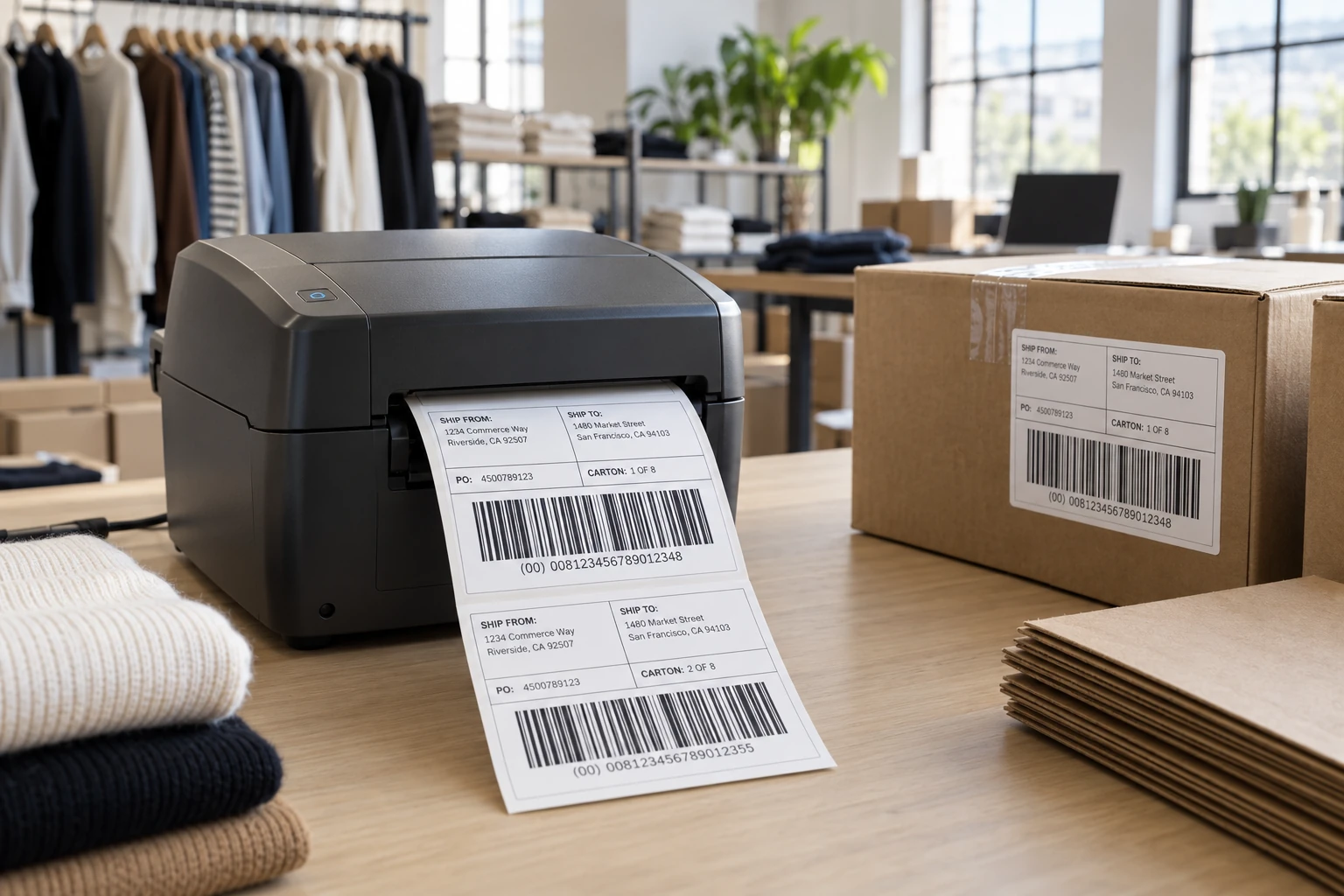
GS1-128 vs. UCC-128: same barcode, new name
GS1-128 is the current name for the barcode formerly called UCC-128 (and EAN-128 outside North America). The name changed when the standards organizations merged under GS1. Many retailer guides still say "UCC-128," so you'll see both terms used interchangeably.
How it's different from a UPC
The UPC on your product is built for the checkout counter. It identifies a trade item type, rather than a unique shipping carton.
A GS1-128 barcode is built for the supply chain. It is commonly used on cartons and pallets and it can carry several pieces of information in a single scan, such as:
- A unique carton or pallet number (the SSCC)
- The product number (GTIN) of what's inside
- Batch or lot numbers
- Production or expiration dates
- Purchase order and shipping details
Because it holds more data, a GS1-128 isn't designed to be scanned at the register. It's designed for receiving docks, warehouses, and distribution centers.
How a GS1-128 barcode is put together
Each piece of data in a GS1-128 is introduced by a short code called an Application Identifier (AI), shown in parentheses in the human-readable text. The parentheses themselves are not encoded. The AI tells the scanner what kind of data comes next and how long it is.
The most common ones you'll see on retail carton labels:
| AI | What it means |
|---|---|
| (00) | SSCC: the 18-digit serial shipping container code that uniquely identifies the carton |
| (01) | GTIN of the trade item being identified |
| (02) | GTIN of contained trade items, used with the appropriate count and SSCC data |
| (10) | Batch or lot number |
| (11) | Production date |
| (17) | Expiration date |
| (420) | Ship-to postal code |
For most fashion and retail suppliers, the barcode that matters most is the SSCC, AI (00). It's the license plate for each carton you ship.
Anatomy of the SSCC
An SSCC is 18 digits long and is built from:
- An extension digit that you assign to expand your numbering capacity
- Your GS1 Company Prefix, which identifies your company
- A serial reference that you assign so no two cartons share a number
- A check digit calculated from the digits before it
Each logistic unit needs its own SSCC. Do not duplicate numbers across active shipments. GS1 requires at least one year from shipment before reallocation; retailer or regulatory rules may require longer.
Where the GS1-128 lives: the shipping label
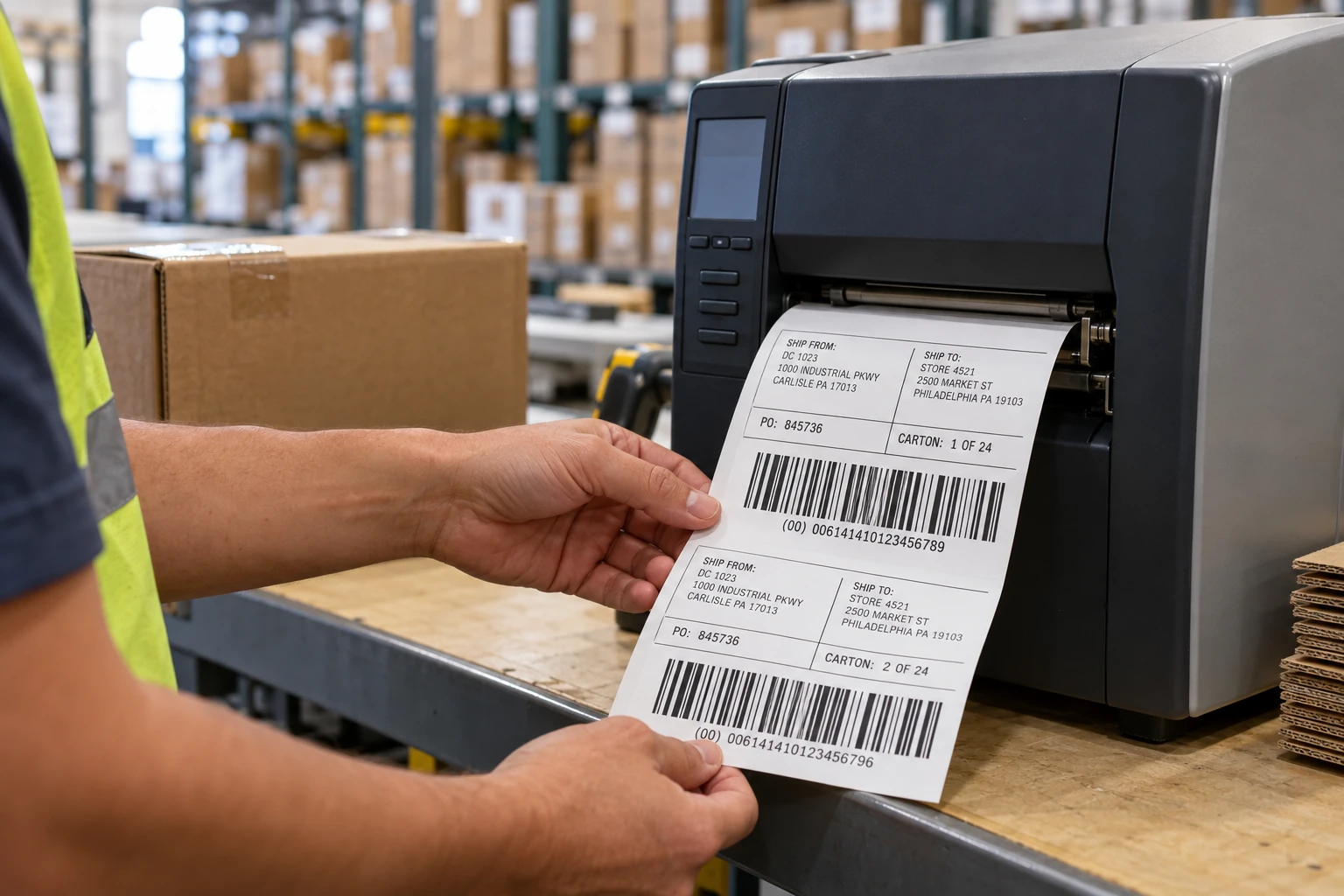
Retailers don't just want a barcode. They want it on a GS1 logistic label laid out to their specifications. A typical retail carton label is divided into zones:
- Ship from / ship to: your address and the retailer's DC or store
- Carrier information: carrier name, PRO number, and routing barcode
- Order details: PO number, department, store number, and carton count (e.g., "Carton 3 of 12")
- SSCC barcode: the GS1-128 encoding the carton's unique number, usually at the bottom of the label
Each retailer has its own rules for label size, zone placement, required fields, and fonts. A label that works for one trading partner may be rejected by another.
Why the label has to match your ASN
This is where most problems start.
When you ship, you send the retailer an 856 advance ship notice (ASN) listing every carton by its SSCC and exactly what's inside it. When the carton arrives, the DC scans the GS1-128 label and matches it against the ASN.
If the carton number on the label doesn't match the ASN, or the ASN arrives late, or the contents don't line up, the retailer can't receive the carton automatically. These errors can lead to receiving delays and EDI-related chargebacks.
Common GS1-128 label problems that lead to chargebacks:
- Carton numbers that don't match the ASN
- Duplicate or reused SSCCs
- Missing or incorrect PO, store, or department numbers
- Labels that don't follow the retailer's layout
- Barcodes that are poorly printed or won't scan
- Labels placed in the wrong spot on the carton
How Roundhouse handles GS1-128 labels for you
Roundhouse is a fully managed EDI provider for fashion and retail suppliers. Your carton labels and ASNs are built together from the same shipment details, so they match.
- Labels built to each retailer's spec. We know the layout and data requirements for your trading partners, so you don't have to study each one's guide.
- SSCCs generated correctly. Carton numbers built using your authorized GS1 Company Prefix and controlled to avoid duplicates.
- Labels and ASNs that agree. The same carton data feeds both, so what's on the box is what's on the 856.
- On-time transmission. We prepare and send ASNs to meet your retailer's required window using the shipment details you provide.
- Help when something goes wrong. If a chargeback hits, we help find the cause and fix it so it doesn't repeat.
You give us the shipment details. We produce compliant labels and documents, ready to print and ship.
Frequently asked questions
Do I need a GS1 Company Prefix to create GS1-128 labels?
To allocate your own SSCCs, you need an authorized GS1 Company Prefix, available through your local GS1 organization. Having individually licensed UPCs does not necessarily mean you have a Company Prefix. We confirm your numbering setup during onboarding.
Is a GS1-128 label the same as a UCC-128 label?
Yes. UCC-128 is the older name. Many retailers still use it in their requirements.
Can I print GS1-128 labels on my own printer?
Usually, yes. Most suppliers use a thermal label printer, typically 4" x 6". What matters is that the barcode prints clearly and the layout matches your retailer's requirements.
What happens if my label doesn't scan?
The DC may have to process the carton by hand, and many retailers charge a fee for that. Repeated problems can affect your vendor scorecard.
Do all my retailers want the same label?
No. Most follow the GS1 standard but add their own requirements for layout, fields, and placement. That's one of the main reasons suppliers turn to Roundhouse.
Can Roundhouse create labels if I'm new to EDI?
Yes. We handle trading partner setup, labels, ASNs, invoices, and everything in between, whether you're onboarding your first retailer or managing dozens.
Ready to get your carton labels right?
Roundhouse has helped fashion and retail suppliers meet retailer requirements for more than 20 years. We handle GS1-128 labels, ASNs and the EDI details that connect your shipments to your trading partners.
Get help with GS1-128 labelsLabels for your trading partners
Explore our Nordstrom EDI services, Macy’s EDI services and other trading partner services.